


**This post contains affiliate links, and if you purchase anything using these links, I will earn a small commission with no additional costs to you.
Enter a Dreamlike Victorian World of Mystery and Power
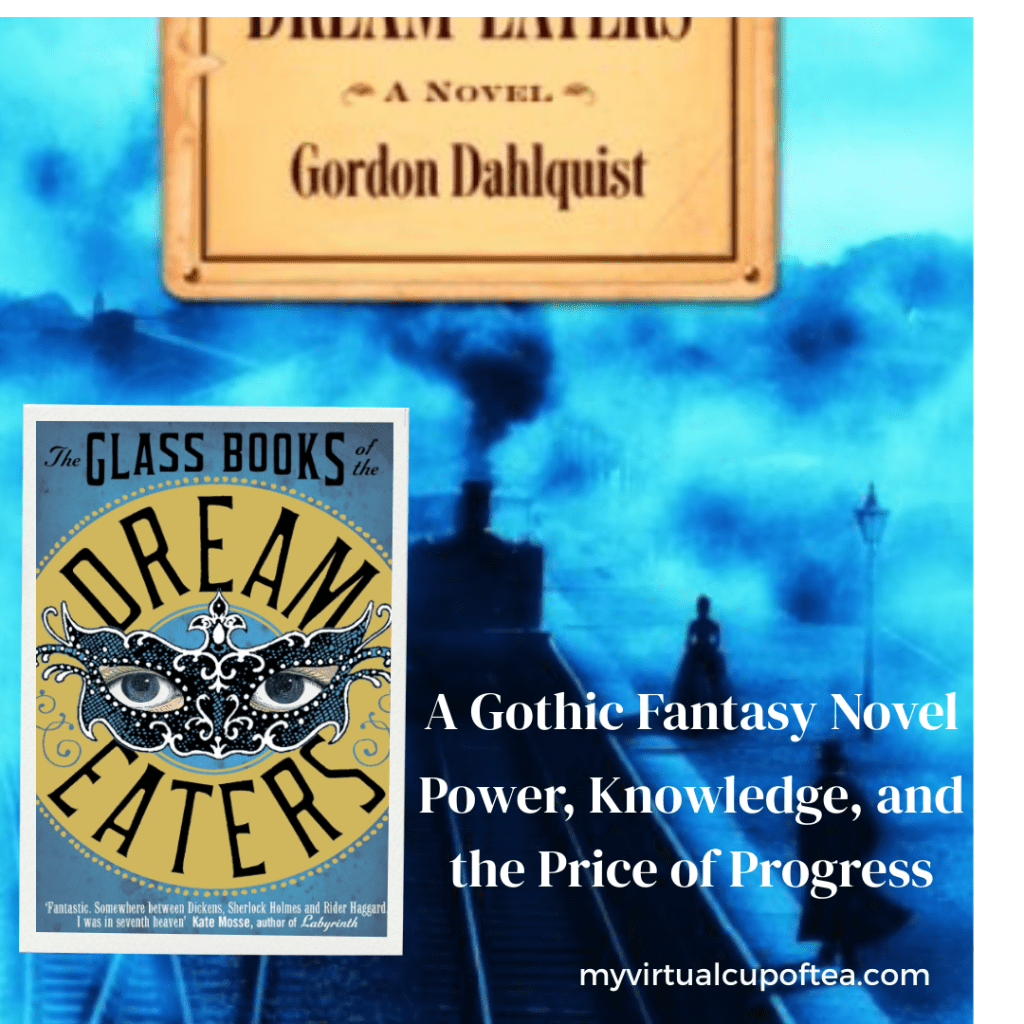
The Glass Books of the Dream Eaters by Gordon Dahlquist is a decadent cocktail of Victorian adventure, gothic mystery, early science fiction, and dark fantasy. First published in 2006, it whisks you into a 19th-century world where secret societies, experimental technology, bizarre inventions, and sinister power plays collide. It’s a book that doesn’t rush you—it invites you to sink in, pay attention, and enjoy the deliciously strange journey, and lose yourself in its peculiar world.

A Victorian World with a Sinister Twist
From the very first pages, Dahlquist establishes an atmosphere that feels fog-soaked, dangerous, and intellectually sharp. The setting is unmistakably Victorian—think gas lamps, rigid social hierarchies, and strict etiquette—but underneath that polished surface is a world buzzing with hidden agendas and unsettling discoveries.
This is no light, whimsical historical fantasy. Instead, it’s dense, moody, and gloriously complex—a treat for anyone who craves immersive worlds and stories with layers to peel back.
A Plot Built on Mystery, Not Hand-Holding
At its core, The Glass Books of the Dream Eaters revolves around a conspiracy involving strange books, experimental devices, and an elite group determined to control knowledge—and people. The plot unfolds gradually, often withholding explanations until you’ve earned them.
This is very much a “trust the process” kind of novel. Dahlquist doesn’t spoon-feed details, and while that may feel challenging at times, it’s also part of the book’s appeal. The mystery deepens organically, pulling you forward with questions rather than easy answers.
Complex Characters Who Drive the Story
One of the novel’s strengths is its cast of characters, particularly its determined and unconventional heroine. Rather than relying on charm or coincidence, the characters survive through intelligence, persistence, and adaptability.
What’s refreshing is that no one feels overly modern despite the genre blend. Their decisions are shaped by the social rules and limitations of the time, which adds realism and tension. Moral ambiguity plays a big role here—very few characters are purely good or evil, making the stakes feel higher and more personal.

Themes: Power, Knowledge, and Control
Beneath the adventure and intrigue, this book asks some fascinating questions:
- Who controls knowledge—and at what cost?
- How far should science go when ethics are ignored?
- What happens when progress is weaponised?
These themes are woven seamlessly into the narrative, never feeling preachy but always present. The novel leans heavily into the idea that information is power, and that power can be deeply corrupting in the wrong hands.
Trust was a currency, and everyone spent it poorly.

The Eerie Weight of Power in the Wrong Hands
What truly haunts you while reading The Glass Books of the Dream Eaters isn’t just the shadowy experiments or secretive figures—it’s the slow realisation of how casually power is taken, justified, and ultimately abused. Dahlquist presents power not as something seized in dramatic moments, but as something accumulated quietly, rationalised through intellect, privilege, and “progress.”
The most unsettling aspect is how reasonable it all seems to those wielding it. Knowledge becomes a currency, innovation becomes an excuse, and human lives are reduced to variables in an experiment. There’s an eerie familiarity to this corruption—it doesn’t feel fantastical so much as disturbingly plausible. That’s what lingers long after you close the book: the sense that actual danger rarely announces itself. It works patiently, invisibly, and with conviction.
As a reader, you’re left with a quiet unease, a creeping awareness that the most terrifying villains aren’t driven by chaos, but by certainty—the belief that their vision of the world outweighs the cost of those crushed beneath it. And that realisation follows you, page after page, refusing to be shaken.
Writing Style: Rich, Dense, and Atmospheric
Dahlquist’s prose is lush and deliberate, ideally suited to the gothic tone. Descriptions are vivid without being excessive, and the pacing—while slow in places—serves the story’s complexity.
This is not a skim-and-scroll kind of book. It demands your full attention, and in return, delivers a reading experience that feels immersive and intellectually satisfying.

Who Should Read This Book?
You’ll likely love The Glass Books of the Dream Eaters if you enjoy:
- Gothic or Victorian-era fantasy
- Intricate plots with slow-burning reveals
- Dark science fiction elements
- Books that reward patience and close reading
If you prefer fast-paced stories with constant action, this might feel heavy. However, if you love getting lost in a strange, intelligent world brimming with gothic and Victorian-era fantasy, intricate plots with slow-burning reveals, and dark science fiction elements, The Glass Books of the Dream Eaters is well worth the commitment. Ideal for readers who appreciate books that reward patience and close reading. On the other hand, those seeking lighter, action-driven narratives might find this novel a bit demanding.

Why This Book Is Worth Your Time
The Glass Books of the Dream Eaters is bold, unsettling, and deeply imaginative. It is a novel that doesn’t play it safe, embracing complexity, darkness, and ambiguity with a refreshingly confident tone. While it demands more from its readers than your average fantasy novel, it gives back tenfold in atmosphere, ideas, and sheer originality. The Glass Books of the Dream Eaters leaves you with a quiet, creeping unease. Power doesn’t arrive in dramatic bursts of villainy; it settles in slowly, justified by intellect, masked as progress, and insulated by privilege. Knowledge becomes leverage. Innovation becomes permission. And human cost fades into abstraction.
If you’re in the mood for a thought-provoking Victorian fantasy that lingers long after the final page, try The Glass Books of the Dream Eaters—dense, atmospheric, and full of slow-burn intrigue.
Myvirtualcupoftea.com is a participant in the Amazon Services LLC Associates Program, an affiliate advertising program designed to provide a means for sites to earn advertising fees by advertising and linking to Amazon.com and affiliated sites. Thank you for supporting my blog!
 My Virtual Cup of Tea